





Boort Community Ground
Concept Overview
Lake Boort was once a natural freshwater marsh; however, colonial-era water resource regulation and the introduction of channels substantially modified both its ecology and Dja Dja Wurrung culture. This project therefore began with a simple yet central question: “How can architecture help people understand the ecological and cultural damage at Lake Boort and participate in its healing?” In response, the design applies a gentle, environment-responsive approach. It looks to Indigenous low-impact interventions, allowing natural processes to guide ecological renewal.
The “Boort Community Ground” is envisioned as a cultural and ecological place of care, providing spaces that support Dja Dja Wurrung knowledge and practices. In this vision, outdoor cultural practice and ecological repair are prioritised, while architecture acts only as minimal support.
The design is guided both by the principles of “Walking Up Country, Talking Up Country” and by Ingold’s concept of “in the open”, where wind, light, moisture and earth continually mingle. Through this approach, the project weaves landscapes and architecture together into an infrastructure that supports ecological repair and cultural continuity, enabling a respectful dialogue between people and Country.
Siting Analysis
The project site is located on the eastern shoreline of Lake Boort. It is currently Paul House Land, though it will soon be returned to the Dja Dja Wurrung Community. The land is generally flat yet slightly elevated above the flood-prone zone, and it is rich in scar trees. The northern edge connects to the main road and pathway, while the eastern boundary opens to farmland, positioned only a five-minute drive from town.
Spatial Strategy
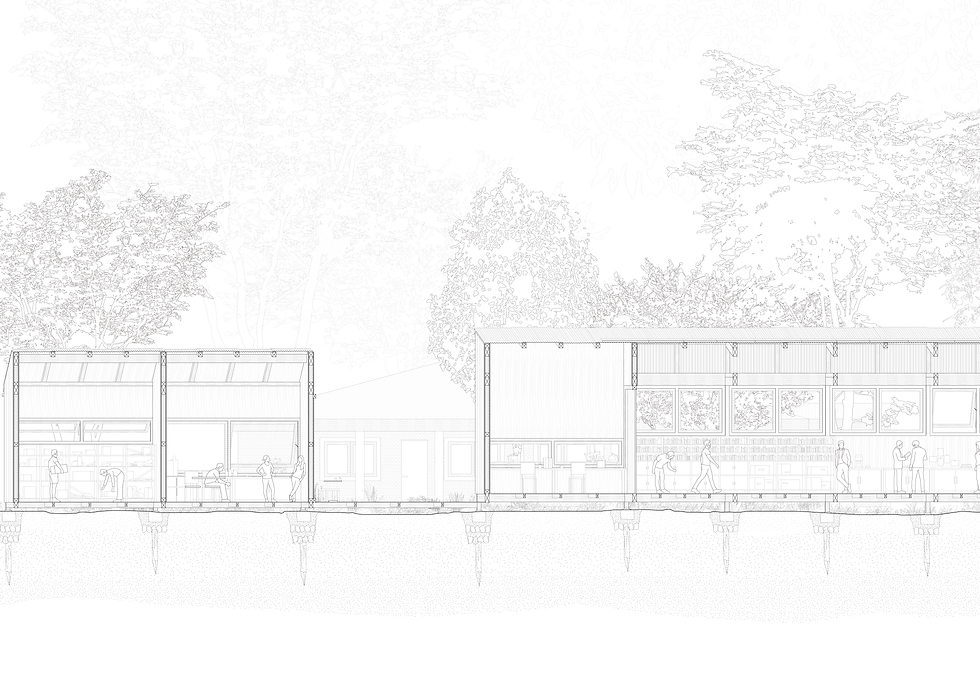
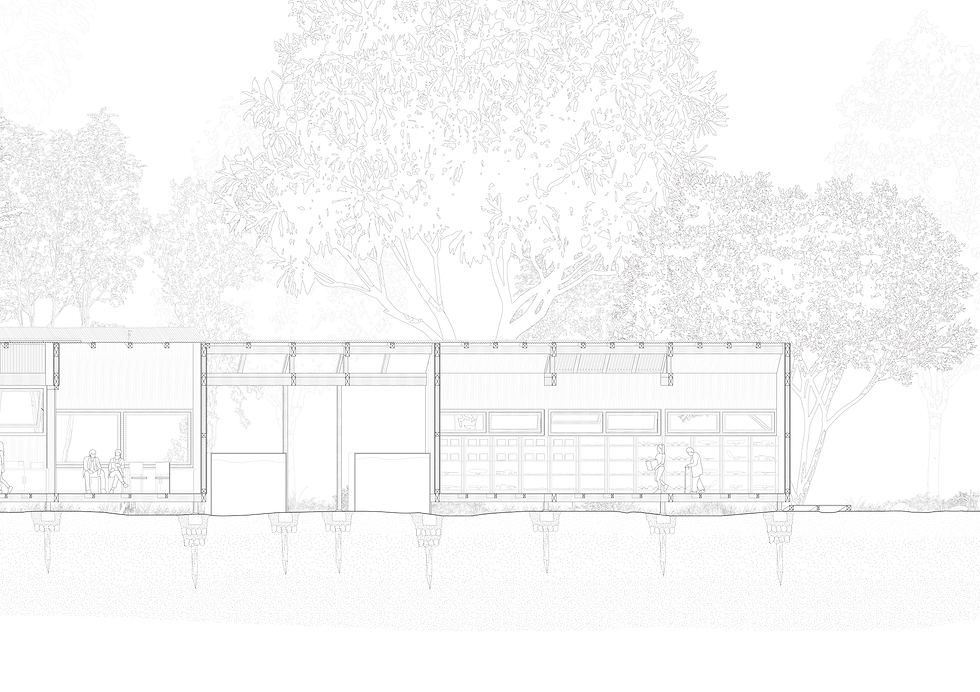
The spatial layout and functions follow the concept of “architecture as infrastructure,” forming an enabling framework for cultural and social activities. Accordingly, the project integrates functions from “public to private,” progressing sequentially from north to south—from gathering spaces to storage and research areas, and finally to the keeping place, a secure and community-controlled space for cultural belongings.
The indoor space and other public gathering areas together form the core zone for communication. Meanwhile, the transitional platform serves both as the main entrance and as a spatial buffer between semi-private and private zones. The private spaces are exclusively used by the Dja Dja Wurrung Community.
To reduce the building footprint, all major circulations are positioned on external decking. The original Paul House has been redesigned into accommodation, continuing to use its original structure and materials in order to minimise environmental impact.
Material and Environmental Strategy
The building sits lightly above the ground, using glulam and metal joints to enhance structural strength. The floor is raised by 300–600 mm to allow for natural plant growth beneath. The foundation employs natural materials such as stone and timber to minimise disturbance.
In addition, the design incorporates natural ventilation and lighting, woven panel shading, solar panels and rainwater collection. These strategies collectively improve energy efficiency and reduce carbon emissions. Each environmental measure is not only a climate-responsive action but also a practice of “touching the earth lightly,” minimising technological intervention to harmonise with the site’s ecological context.
Experiential Strategy
Spatially, the project adopts a “framing views” strategy. Rather than simply “selecting” scenery for users, it offers them the possibility of “choosing” their own views. Sliding glass doors and woven panel shading enable flexibility and visual transparency.
Inside, each functional space includes a service area that determines both window size and height. Timber finishes extend the natural texture of the exterior, softening the threshold between inside and outside, and strengthening the continuity between people, architecture and Country.
Through this project, I hope architecture can become a quiet listener to Country—one that helps repair not only land, but also relationships.